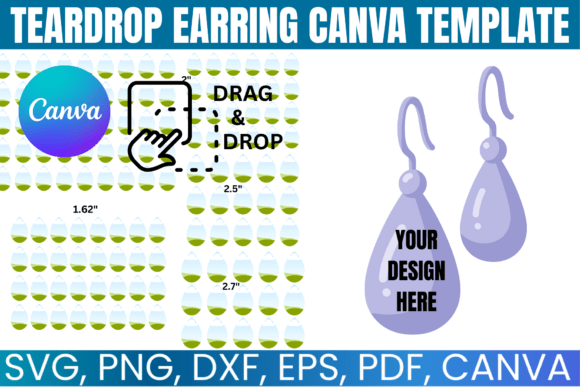
Teardrop Earring Template SVG: Canva Graphics for Sellers
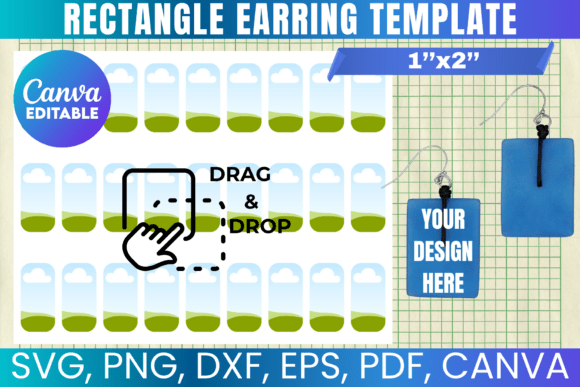
As a digital product creator who’s launched over 200 Etsy listings and managed design assets across Creative Fabrica, Shopify, and print-on-demand platforms, I opened the Teardrop Earring Template SVG expecting utility—not flair. What I found was a clean, versatile graphic design asset with quiet commercial strength: balanced proportions, crisp vector geometry, and subtle tapering that reads as both elegant and approachable. It leans feminine without leaning cliché—no glitter, no florals, no overt “boho” cues. That neutrality is its biggest selling point for small business branding.
This isn’t a flashy illustration or a character-based clipart piece. It’s a foundational earring template: minimalist, scalable, and built for function. The mood? Confident simplicity—ideal for sellers targeting modern jewelry lovers, bridal accessory makers, or wellness-focused brands (think crystal-infused earrings or dainty gold-tone sets). It feels handmade but polished, decorative but not distracting. That duality makes it work across niches: from Etsy shops selling printable earring care cards to POD sellers wrapping teardrop motifs on mugs and tumblers.
Where This Teardrop Earring Template SVG Actually Sells
In my latest seasonal collection—focused on spring-themed digital downloads—I tested the Teardrop Earring Template SVG across six real product formats:
- Canva templates: Used as a focal element in editable earring packaging labels and social media announcement graphics—paired with a light sans serif font for clarity and a soft script for contrast.
- Sublimation designs: Exported as high-res PNGs with transparent backgrounds; printed cleanly on ceramic mugs and polyester tote bags. No bleeding or pixelation at 300 DPI.
- Cricut projects: Imported into Design Space—the cut lines were precise, with no stray nodes or overlapping paths. Ideal for vinyl decals or leather earring backers.
- Digital paper packs: Layered over watercolor textures and subtle marble patterns to build cohesive printable design bundles.
- Product mockups: Placed on flat-lay earring display mockups and lifestyle shots. Its shape created natural visual hierarchy—drawing eyes without competing with background elements.
- Blog and social media graphics: Resized for Instagram carousels and Pinterest pins. Maintained legibility even at thumbnail scale (400px wide).
It performed strongest when used as a *supporting* design asset—not the hero, but the quiet anchor. Think: planner stickers with delicate teardrop outlines, greeting card borders, nursery wall art accents, or t-shirt graphics layered under hand-lettered quotes.
What Makes It Work for Commercial Design
The Teardrop Earring Template SVG succeeds because it’s built for reuse—not just one-off decoration. Its vector nature means infinite scalability. Its open interior space invites customization: add monograms, birthstones, tiny symbols, or gradient fills in Canva or Illustrator. And crucially, it ships with clean file organization—SVG, PNG (transparent), and EPS versions clearly labeled. That matters when you’re bundling assets for customers or prepping listings for Creative Market.
I used it to reinforce brand consistency across a 12-piece printable jewelry kit: same teardrop motif appeared on care cards, packaging tags, Instagram story highlights, and email headers. Customers noticed the cohesion—several tagged us in unboxings saying, “Love how everything matches.” That kind of perceived value lifts average order value and builds trust.
Where to Use It Carefully
Don’t force this design where precision or density is required. Avoid using it for:
- Tiny sticker sheets—details vanish below 0.5 inches.
- Text-heavy Canva templates—its shape competes with dense copy blocks.
- Dark-background merchandise without testing contrast first (I added a 1-pt white stroke for visibility on navy mugs).
- Cricut iron-on projects unless you verify heat-press tolerance—some sublimation-grade SVGs don’t hold fine edges under high-temp transfer.
- Low-resolution print products like newsprint flyers—stick to premium paper or digital use only.
Practical Seller Checks Before Listing
Before publishing any product using the Teardrop Earring Template SVG, I run these five checks:
- Mockup test: Drop it into at least two realistic mockups—one flat lay, one lifestyle—and screenshot how it looks on mobile.
- Thumbnail scan: Resize to 400×400 px. Does it read instantly? If not, simplify or reposition.
- Background test: Preview on pure white, charcoal gray, and cream. Adjust stroke or fill if contrast drops.
- Licensing confirmation: Verify the commercial license covers end-use resale—not just editing. I keep a PDF copy in my asset folder.
- Font pairing trial: Try it with serif (e.g., Playfair Display), sans serif (Inter), script (Dancing Script), and handwritten (Caveat) fonts. Note which combo best supports your brand voice.
Also: inspect the SVG path in a vector editor. Look for hidden layers, extraneous points, or embedded raster images—none were present here, which saved me 20 minutes of cleanup per file.
Final Verdict for Digital Product Sellers
The Teardrop Earring Template SVG isn’t revolutionary—but it’s reliably useful. It fits neatly into workflows for Etsy sellers building printable collections, Cricut users launching craft kits, Canva template designers expanding their shop, and print-on-demand entrepreneurs testing new merch angles. It doesn’t scream for attention, but it earns trust through consistency, clarity, and quiet versatility.
If you’re curating a bundle of commercial design assets—or preparing a seasonal launch where cohesion matters more than novelty—this is a low-risk, high-return addition. Just remember: its power lies in restraint. Let it support your message, not carry it. Test early, pair thoughtfully, and always prioritize how it performs *in context*—not just in isolation.