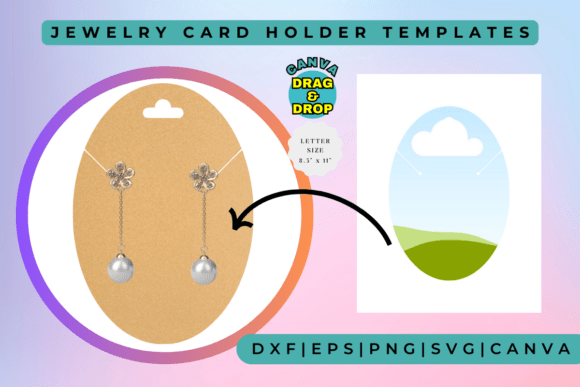
Jewelry Card Holder Templates
First Impressions: Clean, Purposeful, and Quietly Sophisticated
Opening Jewelry Card Holder Templates in Canva, I immediately noticed how thoughtfully restrained it is—not fussy, not overly decorative, but unmistakably intentional. It’s a set of minimalist card holder outlines: clean lines, subtle rounded corners, light negative space, and just enough visual weight to hold attention without shouting. This isn’t a “busy” embroidery file or an applique design begging for sequins and puff. It’s quiet confidence—like the kind you’d choose for a boutique gift tag, a linen apron label, or a monogrammed tea towel meant to live on a kitchen counter for years.
Real-World Test: Stitching It Onto a Linen Pillow Cover for a Local Jewelry Maker
Last week, I used Jewelry Card Holder Templates as part of a custom order: three embroidered linen pillow covers for a small-town jewelry designer launching her holiday collection. She wanted something elegant but functional—spaces where customers could tuck in a handwritten note or care instructions alongside a piece of handmade jewelry. We stitched the template onto the bottom corner of each cover using a medium-density satin stitch border and soft fill stitch interior. On natural linen, the result was crisp, legible, and quietly luxurious—no bleeding, no puckering, no need for heavy backing. Customers commented on how “thoughtful” and “finished” the detail felt—not like an afterthought, but part of the product’s story.
Where It Shines (and Why)
- Custom apparel & tote bags: Works beautifully scaled up on cotton canvas or denim—clean edges stay sharp even at 3.5" wide, and the open interior leaves room for hand-lettered notes or printed inserts.
- Sweatshirt embroidery & baby items: When sized down to 2", it reads clearly on ribbed knit or interlock without overwhelming delicate fabric. No dense fill stitch clusters that risk stiffness or discomfort.
- Embroidered patches & aprons: The balanced proportions make it ideal for sew-on or iron-on patches—especially when paired with a single-color thread palette (navy on cream, charcoal on oat, etc.).
- Holiday gifts & wedding favors: Its neutral structure invites personalization—add a tiny initial, a date, or a short sentiment inside the frame without cluttering the design.
- Etsy listings & printable mockups: As a Graphics asset in Canva, it layers cleanly over product photos. I dropped it into a mockup of a ceramic jewelry dish—and instantly elevated the perceived value of the listing.
Where to Pause (and Plan Ahead)
This isn’t a one-size-fits-all embroidery file—and that’s actually its strength. But it does ask for intentionality.
On stretchy fabric (like jersey tees or baby onesies), I recommend stabilizing heavily and reducing stitch density slightly—especially along the outer frame—to avoid distortion. On dark fabric, test thread contrast first: light gray or ecru satin stitch reads softer than white, and avoids glare under display lighting. And on curved surfaces like caps? Stick to the smallest version—it holds shape better than larger iterations when hooped on a curved bill.
Also: avoid cramming fine lettering or tiny icons into the interior unless you’ve verified stitch clarity at your target size. What looks elegant at 4" on screen may blur at 1.5" in thread—especially with lower-thread-count stabilizer or high-speed stitching.
What It Adds to Your Finished Product (Beyond the Obvious)
Jewelry Card Holder Templates doesn’t just hold a note—it signals care. That matters deeply for handmade products, personalized gifts, and small shop merchandise. When a customer receives a hand-stitched item with this detail, they don’t just see function—they feel intention. It boosts customer trust (this maker pays attention to details), strengthens brand consistency (a repeatable, refined touchpoint across packaging, tags, and displays), and increases giftability—because thoughtful presentation makes even simple items feel special.
For Etsy sellers and craft fair vendors, it also adds quiet professionalism. A well-executed card holder says more about your standards than any banner or bio ever could.
Practical Designer Notes (From My Hoop to Yours)
- Always run a test stitch on scrap fabric—especially if pairing with textured weaves like burlap or bouclé.
- Check thread color contrast against both light and dark backgrounds before finalizing your palette.
- Review stitch density: If your machine flags tension issues, simplify interior fills or switch to a running stitch outline instead of full satin.
- Confirm hoop size compatibility—some versions fit comfortably in a 4x4 hoop; others stretch toward 5x7. Don’t assume.
- Inspect small details at actual stitch size: zoom in on your embroidery software preview, then check again in black-and-white mode to assess clarity.
- Use appropriate stabilizer: medium-weight cutaway for knits, tear-away for stable wovens, and lightweight fusible for delicate linens.
- Verify licensing terms before selling finished items or bundling this as part of a digital product—you’re responsible for commercial use rights.
Final Thought: A Design That Serves, Not Distracts
Jewelry Card Holder Templates won’t win awards for flash—but it earns respect for reliability, adaptability, and quiet elegance. It’s the kind of design that disappears into your workflow while elevating your output. Whether you’re embroidering a baby blanket for a friend or building a cohesive line of boutique merchandise, it delivers consistent polish without demanding extra time or troubleshooting. For craft business owners who value both efficiency and authenticity, it’s less of a “template” and more of a trusted tool—one you’ll reach for again and again.