Pocker Playing Card Deck SVG Templates 1
First Impressions: A Playful, Print-Ready Canvas — Not a Plug-and-Stitch Embroidery File
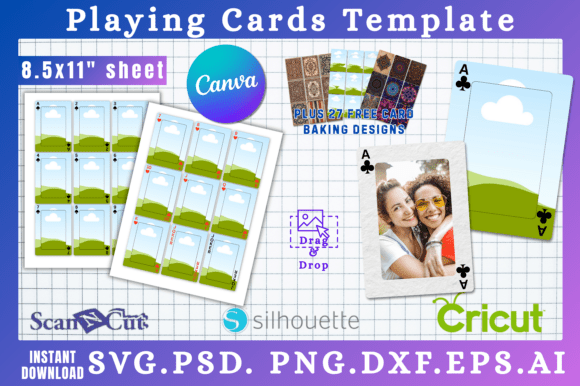
Let’s be clear upfront: Pocker Playing Card Deck SVG Templates 1 isn’t a machine embroidery design. It’s a Canva-friendly graphic — a clean, scalable vector layout designed for an 8.5 x 11 sheet. As an embroidery designer who’s stitched hundreds of playing card motifs (from poker-themed baby onesies to boutique aprons), my first reaction was cautious optimism. The template has strong visual rhythm — balanced suits, consistent sizing, and open negative space between cards — which hints at adaptability. But it’s not optimized for thread. There’s no stitch mapping, no satin-stitched edges, no fill-stitch density control. Think of it as your sketchbook page before you translate the idea into thread.
Real-Life Test: Turning It Into a Custom Embroidered Tote Bag
Last week, I used Pocker Playing Card Deck SVG Templates 1 as the starting point for a small-batch embroidered tote bag series — meant for a local game shop’s holiday pop-up. I imported the SVG into my digitizing software, isolated one ace of spades, resized it to fit a 4” hoop, and rebuilt it with tight satin stitches for the suit icon and subtle running stitch outlines for the card border. The result? A crisp, confident motif that held up beautifully on medium-weight canvas. Customers loved the playful yet polished look — especially when paired with charcoal thread on natural linen. But here’s what almost derailed it: the original template’s tiny serif font for “ACE.” At embroidery scale, those thin strokes vanished entirely. I swapped it for a bold, condensed sans-serif — a reminder that Pocker Playing Card Deck SVG Templates 1 gives you structure, not stitch-ready detail.
Where It Shines — And Where It Needs Your Hand
This template works best when you’re the designer *and* the stitcher — not when you’re handing off a file to a production embroiderer expecting plug-and-play results. It fits naturally in:
- Custom apparel: Great base for sweatshirt chest logos or t-shirt pocket accents — if you simplify shapes and reinforce outlines.
- Embroidered patches: Ideal for iron-on or sew-on patches where you want uniform card spacing across a set.
- Baby embroidery: The clean lines translate well to soft satin-stitched crib mobiles or onesie appliqué — just avoid fine interior details.
- Holiday and wedding gifts: A subtle, non-cliché motif for personalized tea towels or pillow covers — especially when stitched in tonal thread.
- Craft business branding: Use individual cards as icons in your Etsy shop banners, printable mockups, or packaging labels.
Use With Care: Fabric, Hoop, and Detail Realities
You’ll want to pause before applying Pocker Playing Card Deck SVG Templates 1 directly to certain projects:
- Small hoop sizes (under 3”): The full deck layout won’t fit. You’ll need to extract and resize single cards — and test how corners and curves hold up in dense fill stitch.
- Textured or stretchy fabric: Thin outlines or interlocking suit elements may distort. Add stabilizer generously — tear-away works for cotton; cut-away is safer for knits.
- Dark or black fabric: Light-colored thread will pop, but tiny white highlights in the original SVG won’t translate unless you manually add underlay or use metallic thread.
- Curved surfaces like caps: Avoid multi-card layouts here. Stick to one central suit or simplified corner motif — and always do a cap hoop test first.
- Frequent-wash items (baby clothes, kitchen towels): Skip delicate interior linework. Reinforce outer edges and avoid ultra-thin connecting strokes that fray over time.
What This Means for Your Handmade Product & Customer Trust
When customers see a well-executed playing card motif on your finished product — say, a linen apron with a rich black satin-stitched king of hearts — they don’t just see decoration. They see intention, craft, and confidence. Pocker Playing Card Deck SVG Templates 1 supports that impression only when treated as a springboard, not a shortcut. Used thoughtfully, it elevates brand consistency (think matching tote + patch + digital shop banner) and strengthens buyer engagement through cohesive, recognizable design assets. Used hastily — without adjusting stitch density, testing contrast, or refining corners — it can undermine professionalism and make your handmade product feel generic.
Practical Designer Notes Before You Stitch
Before turning Pocker Playing Card Deck SVG Templates 1 into a real embroidery project:
- Test the design on scrap fabric first — especially with your intended stabilizer and thread combo.
- Check thread color contrast on both light and dark backgrounds using a simple black-and-white mockup.
- Review stitch density: too dense = puckering; too sparse = gaps. Adjust fill angles for smoother coverage on curves.
- Confirm your hoop size matches the final stitched area — don’t assume the 8.5 x 11 layout scales linearly.
- Inspect small details: serifs, interior cutouts, and fine lines often vanish or break in stitching — simplify or eliminate them.
- Use proper stabilizer — medium-weight cut-away for stretchy fabrics, lightweight tear-away for stable wovens.
- Verify licensing terms before selling finished items or digital products — this is a graphics file, not pre-cleared commercial embroidery content.
Final Thought: A Tool That Rewards Thoughtful Translation
Pocker Playing Card Deck SVG Templates 1 won’t save you digitizing time — but it will save you from staring at a blank screen. It’s a smart, flexible foundation for designers who understand that great embroidery starts long before the needle moves. Whether you’re building a craft business, launching an Etsy line, or making personalized gifts, treat this template like raw material: observe its strengths, respect its limits, and translate its energy into something truly stitched — not just printed.